What to Do If You Can't Read Drum Charts? Beginners—Just Learn These 8 Positions First!
When you first start drumming, have you ever run into this?
Your teacher hands you a drum chart.
You feel excited. Then the next second…
“Ah! I can't understand any of this!” 😂
Don't worry—I was the same.
When I started learning drums
my teacher gave mehandwritten charts. Maybe because the notes were drawn nicely (lol),
and he marked T1 T2 FT with 1 2 F, so I thought they were easy to read.
He even wrote a lot of Japanese songs for me—I’m really grateful thinking back.😊
Two years ago I decided to challenge myself to record a cover each week, so
I started making charts on the computer.
And then…I often couldn’t understand the charts I made and kept entering mistakes.🤣
(I’ll share what software I use to make charts another time.)
Not really.
If you first learn a few of the most common positions, you can already read many pop songs.
I won’t get deep into theory here—let’s start with the simplest approach.
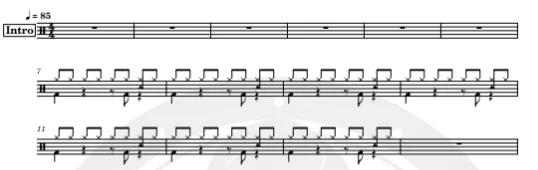
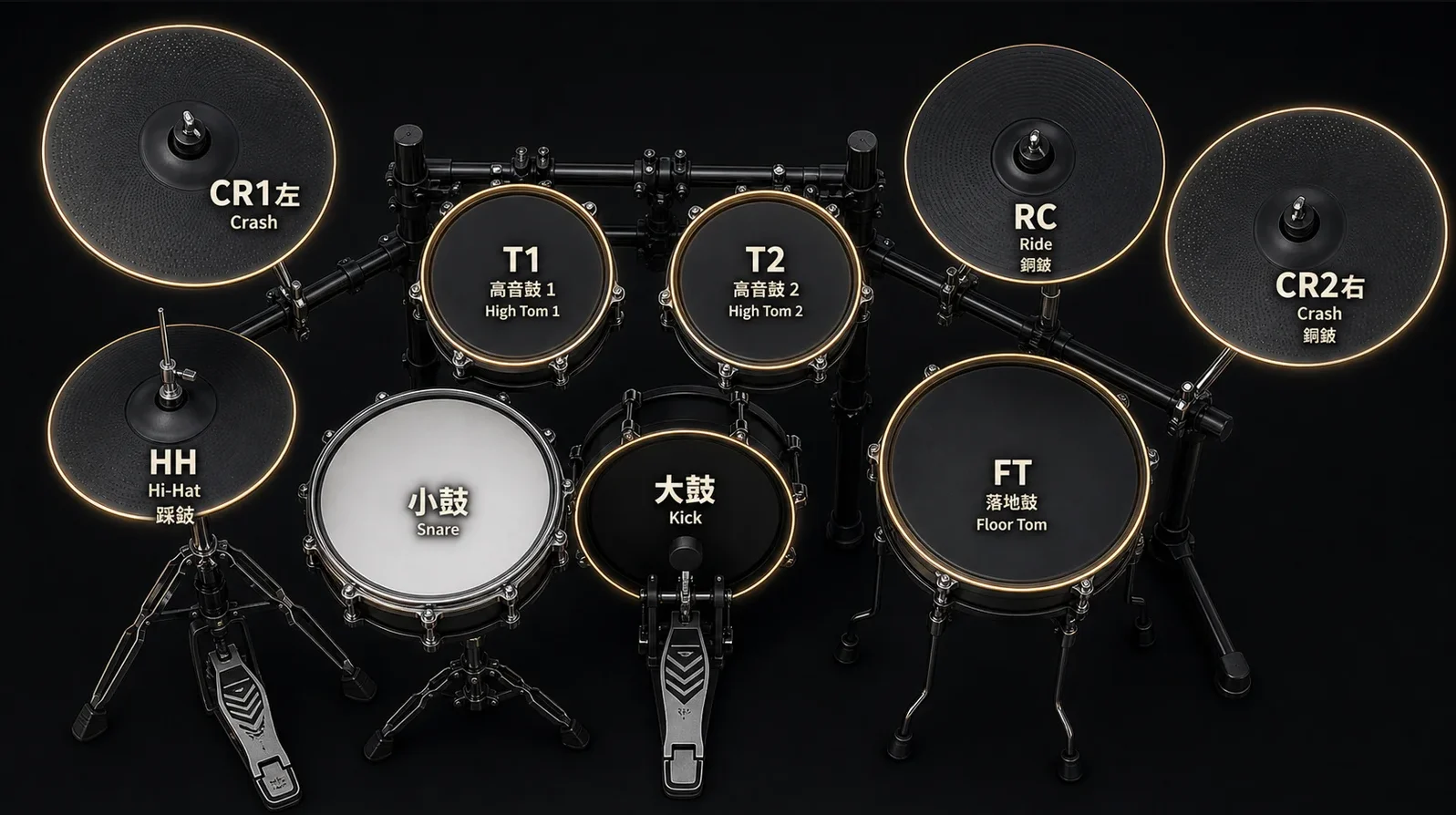
Look at the diagram above to memorize some positions and symbols.
The staff counts lines and spaces from bottom to top: the bottom is the first line, up to the fifth line at the top.
I’ll show one bar of eighth notes for each instrument to make it easier. This is a very common Hi-Hat symbol, usually located above the fifth line of the staff.
If you can only remember four for now,
I recommend:
🥁 Hi-Hat 🥁 Snare 🥁 Bass Drum 🥁 Crash
Because… in most pop songs you’ll see them almost every day.
Hi-Hat
Usually sits at the very top of the staff and is the most frequent symbol.
When you see it, it almost always means the pulse is moving forward.
Crash
Crash often appears together with the bass drum.
So when you see: X + bass drum
it usually means:hit them together! But practice hand-foot coordination or the sounds won’t line up.
Besides the four most common,
there are:
- Ride
- Tom 1
- Tom 2
- Floor Tom
Their positions are fixed—look at enough charts and you’ll remember them.
Ride is an X on the fifth line, T1 is just above the fourth line as a filled note head, T2 is on the fourth line, and FT is just above the second line.If you plot all eight instruments in one measure, it looks roughly like this.At first it may seem messy, but it’s just a few more positions.
I didn’t start with difficult songs.
Instead I kept looking at:eighth notes.
Assuming the HH is steady eighth notes:
- Two hits per beat
- Four beats per bar = right hand HH plays eight times
The rhythm is steady—great for building sight-reading habits.
I also vocalize while playing
For example:
🥁 Snare — say: “ta”
🥁 Bass Drum — say: “dum”
🥁 Hi-Hat — say: “tss”
Crash I usually say: “dum” too
because it often aligns with the bass drum.
If it’s: Hi-Hat + Snare, I still prioritize saying: “ta” for the snare
That way your eyes, voice, and hands learn the chart together. It works very well.
If you're new to reading drum charts, don't rush to memorize everything at once.
Start by learning: [
- Hi-Hat
- Snare
- Bass Drum
- Crash
Then slowly add the other pieces.
Look a little every day, play a little every day.
You’ll soon find:drum charts aren’t as scary as they seem. [😊